
How to Lose Chest Fat as a Man: 6 Steps That Work
The short answer
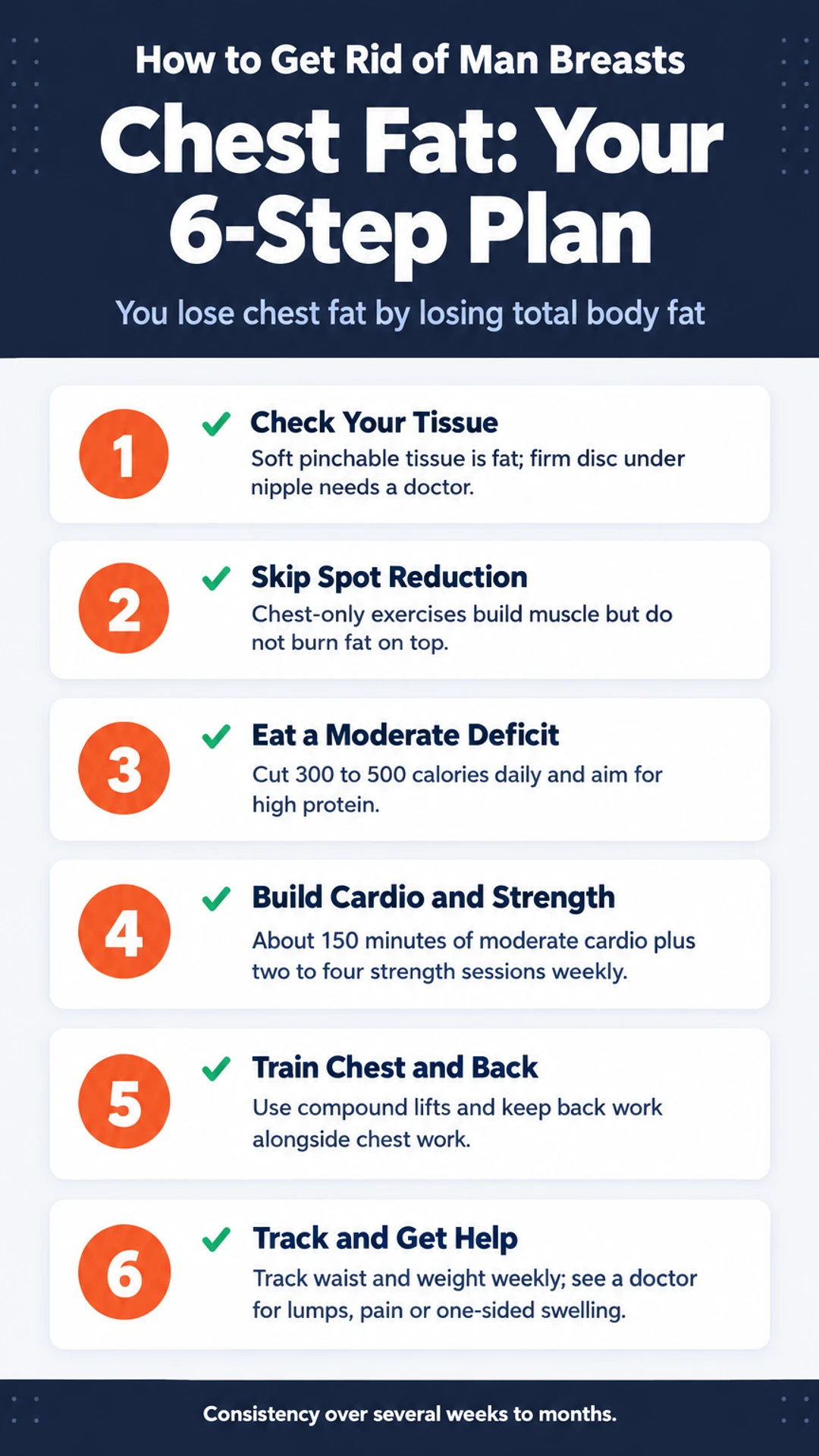
To lose chest fat as a man, reduce your overall body fat. You cannot burn fat from one area alone. Eat in a moderate calorie deficit, keep protein high, do regular cardio, and train your chest, back and full body. Most men see changes over several weeks to months. If the area feels firm, is one-sided, or is tender, see a doctor, because the cause may be glandular tissue.
By the end of this guide, you will have a six-step plan you can start this week, with a realistic sense of how long each part takes to show results.
Chest fat sits on top of the muscle, and the only lever you have over it is your total body fat. That means the steps here cover your diet, your training, and your daily habits together, not a set of chest-only exercises.
Each step builds on the one before. You will set a calorie target you can actually sustain, learn how much protein to aim for, pick cardio that fits your schedule, build a training split that works your chest without neglecting your back, and learn when to stop and see a doctor. If you prefer a shorter timeline or have no gym access, our related guides on reducing chest fat in 10 days, at home, without a gym, and over 30 days cover those situations in more detail.
Quick steps:
- Confirm What You Are Dealing With
- Accept That Spot Reduction Does Not Work
- Set a Moderate Calorie Deficit and High Protein
- Build a Weekly Cardio and Strength Base
- Add Chest and Back Work Built on Compound Lifts
- Track Progress, Stay Consistent, and Know When to Get Help
Guides On This Site
Step 1: Confirm What You Are Dealing With
Before you pick a plan, you need to know what is actually on your chest. Some men carry extra fat across the chest, and some have firmer tissue under the nipple that does not respond to diet the same way. The two need different approaches, so start with a simple check.
A home examination cannot reliably distinguish fat, glandular tissue, and other causes of breast enlargement. If a change is new, unexplained, painful, or concerning, arrange a professional evaluation.
Gynecomastia needs a doctor's view
Glandular enlargement in men is called gynecomastia. It is a medical condition, not a cosmetic one, and it is not reliably fixed by diet and exercise alone. A doctor can assess it, check hormone levels or medications if needed, and discuss options. Surgery exists for persistent cases, and it is worth knowing that before you assume the problem is only fat.
See a doctor promptly if you notice:
- Swelling on one side only
- Tenderness or pain in the breast area
- A lump you can feel under the nipple or in the chest
- Nipple discharge or skin changes
- Breast changes that started after you began a new medication, a supplement, or a hormone therapy
If you have any of these, book a visit before starting an exercise or diet plan. If the pinch test points mainly to fat and none of these signs apply, you can move on to the steps that follow.
Chest Tissue Types at a Glance
| Tissue | What It Feels Like | Next Step |
|---|---|---|
| Chest fat | Soft, pinchable, moves easily | Follow the whole-body plan |
| Glandular tissue | Firm, rubbery disc under nipple | See a doctor |
| Mix of both | Soft fat plus firm disc | Check the firm area with a doctor |
Step 2: Accept That Spot Reduction Does Not Work
Many men start with a plan built around chest exercises, expecting the work to burn the fat sitting on their pecs. It does not. Spot reduction, the idea that training one area melts fat from that area, is not how the body works. Your body draws on fat stores across the whole body, and it decides where to pull that energy from based on genetics, hormones and age, not on which muscle you trained today.
For many men, the chest is one of the last places to lose fat. Fat often comes off the face, arms and midsection first, while the area over the pecs holds on longer. That is frustrating, but it is normal, and it is why the chest needs a whole-body approach.
Chest exercises still matter. Pressing and flying movements build the pectoral muscles underneath the fat, which adds firmness and shape. What they do not do is burn the fat sitting on top. So set the expectation this way: total body fat falling is what makes the chest look flatter. As your overall body fat drops, the area over your chest gets smaller too.
What to do:
- Stop choosing chest-only workouts as your fat-loss plan. Keep them as a supporting part of training.
- Build your routine around whole-body work, such as squats, rows, lunges and full-body circuits, which burn more energy than isolated moves.
- Track your waist measurement and body weight every week, not just how your chest looks in the mirror.
- Set a target for steady, gradual total fat loss, and judge progress by that number over several weeks.
For a concrete plan built around these steps, see our guides on reducing chest fat without a gym and at home, and on a realistic 30-day plan.
Step 3: Set a Moderate Calorie Deficit and High Protein
Chest fat goes down when your whole body burns more energy than it takes in, so this step is about setting up eating habits you can keep for months. Start with a deficit of roughly 300 to 500 calories a day below your maintenance intake. Maintenance is the amount you eat to hold your weight steady. Most people can estimate it with an online TDEE calculator, then subtract that 300 to 500 calories.
Check the trend after two weeks. If your weight drops by about 0.25 to 0.5 kg (roughly half a pound to a pound) per week, keep going. If it does not move, trim another 100 to 150 calories. If you lose faster than that, add some food back, because rapid loss usually costs muscle.
Protein helps you hold onto muscle while you lose fat, which matters for the chest. Aim for about 1.6 to 2.2 grams per kilogram of body weight each day. A 90 kg man would eat roughly 145 to 200 grams. Split it across three or four meals, about 30 to 45 grams at each, with chicken, eggs, Greek yogurt, fish or lean beef.
Next, cut the calories that slip by without filling you up:
- Sugary drinks, including soda, energy drinks and sweetened coffee
- Alcohol, which adds calories and lowers your willpower at night
- Heavily processed snacks like chips, pastries and packaged sweets
Swap these for water, black coffee, or a whole-food snack you actually enjoy.
Step 4: Build a Weekly Cardio and Strength Base
Chest fat goes down when your overall body fat goes down, and a steady weekly routine is the most reliable way to get there. Start with two parts: cardio to burn energy and strength work to keep and build muscle while you lose weight. Set both up once, then repeat them each week.
Aim for about 150 minutes of moderate cardio a week. Moderate means you can talk in full sentences but not sing. Good options include:
- Brisk walking
- Cycling at a steady pace
- Swimming laps
Spread the time across five or more days, roughly 30 minutes each. If you prefer a shorter session, mix in intervals: for example, three minutes of hard effort followed by two minutes of easy pace, repeated for 20 to 30 minutes. Interval sessions count toward your total, but keep most of your cardio at a moderate pace.
Do two to four full-body strength sessions a week. Big compound lifts work several large muscle groups at once, so they burn more energy than isolation moves and help you hold on to muscle as you lose fat. Pick exercises such as squats, deadlifts, rows and push-ups or a bench press, and do two to three sets of 6 to 12 reps. Leave at least one day between sessions.
Here is a sample week for a beginner:
- Monday: strength session, then a 30-minute walk
- Tuesday: 30-minute cycle
- Wednesday: strength session
- Thursday: 30-minute walk
- Friday: strength session
- Saturday: 40-minute swim or cycle
- Sunday: rest or an easy walk
Explore the exercise guide and nutrition guide for more detail.
Weekly Training Targets
| Activity | Weekly Amount | Notes |
|---|---|---|
| Moderate cardio | About 150 minutes | Spread across five or more days |
| Full-body strength | 2 to 4 sessions | At least one rest day between |
| Strength sets | 2 to 3 sets of 6 to 12 reps | Compound lifts |
Step 5: Add Chest and Back Work Built on Compound Lifts
Chest exercises will not burn fat from your chest alone, but they do build the muscle underneath, and that helps the area look firmer as the excess tissue comes off. Pair them with the back work below, because a balanced routine keeps your shoulders and upper body in good alignment.
Start with these movements, two or three times a week:
- Push-ups: Place your hands slightly wider than your shoulders and keep your body in a straight line from head to heels. Lower your chest until your elbows reach roughly 90 degrees, then press back up. If you cannot finish a set with good form, put your hands on a raised surface such as a bench or countertop. The higher the surface, the easier the exercise.
- Bench press or dumbbell press: Lie on a flat bench with your feet planted. Lower the weight to mid-chest, pause, then press up. Dumbbells let each side work independently, which helps if one side is weaker.
- Dumbbell fly or cable crossover: Keep a soft bend in your elbows and bring the weights together in a wide arc over your chest. Control the lowering phase.
- Rows or pull-downs: Use a cable pull-down or a bent-over row to train your lats and mid-back. Squeeze your shoulder blades together at the end of each rep.
For each exercise, do 2 to 3 sets of 8 to 15 reps. Choose a weight that feels challenging by the last two or three reps while your form stays clean. If your form breaks down, the weight is too heavy.
Training your back matters as much as training your front. Strong back muscles support good posture, and posture changes how your chest sits and looks. Many people who focus only on pressing end up rounding their shoulders forward. Balance your sessions so you do roughly as many pulling sets as pushing sets.
Step 6: Track Progress, Stay Consistent, and Know When to Get Help
Chest fat changes slowly, and the scale alone will often hide what is happening. Your body weight can bounce by a few pounds from water, salt, and sleep, so one weigh-in tells you very little. Track several things instead, and you will see the real trend.
What to measure and how often:
- Waist and chest measurements: Measure once a week, first thing in the morning, using a soft tape. Keep the tape level and snug but not tight. For chest, measure around the nipple line.
- Weekly weight average: Weigh yourself every morning after using the bathroom, write each number down, and average the seven readings at the end of the week. Compare that average to the week before.
- Progress photos: Take front, side, and angled shots in the same light, at the same time of day, every 2 to 4 weeks.
Expect change over several weeks to months, not days. Many men notice a difference in the mirror before the tape measure moves, so keep the photos going even when the numbers look flat.
If your weekly average and waist measurement have not moved for about 2 to 3 weeks while you have been consistent, reduce your daily calories by roughly 100 to 200 and keep going. Consistency matters more than intensity. Keep your exercise and strength work steady while you do this, and let the trend guide your next change.
When to see a doctor:
A doctor can check for glandular tissue, hormone imbalances, or medication causes that exercise and diet alone cannot fix. Book an appointment if you have:
- No measurable change after several months of consistent effort
- Chest tenderness, pain, or a firm lump under the nipple
- Nipple discharge or skin changes
- Rapid growth on one side, or a sudden change in breast size
What to do now
- ☐ Do the pinch test in good light to tell fat from firm glandular tissue
- ☐ See a doctor promptly if you notice swelling on one side, tenderness, a lump, or discharge
- ☐ Stop relying on chest-only workouts as your fat-loss plan
- ☐ Estimate your maintenance calories and eat 300 to 500 calories below it
- ☐ Aim for about 1.6 to 2.2 grams of protein per kilogram of body weight daily
- ☐ Schedule about 150 minutes of moderate cardio and two to four full-body strength sessions weekly
- ☐ Add push-ups, presses, flyes and rows, with as many pulling sets as pushing sets
- ☐ Weigh yourself daily, track the weekly average, and measure your waist and chest weekly
Frequently asked questions
Which body part is hardest to lose fat?
Most men find the chest, upper abdomen and lower back among the last places to lose fat, while the arms, face and legs often lean out sooner. Fat loss follows a pattern set largely by genetics and hormones, so the hardest area is usually the one where your body stores the most fat. Your chest tends to slim down once your overall body fat drops.
Can push-ups reduce chest fat?
Push-ups build and firm the chest muscle underneath the fat, but they do not burn fat from that spot. Doing them regularly can improve the shape and firmness of your chest, which helps it look leaner once you lose overall body fat. For fat loss itself, the calorie deficit you create through diet and total activity matters far more.
How do I flatten my chest as a guy?
Flattening the chest comes down to lowering your overall body fat and building the pectoral muscles so they sit fuller under the skin. Chest presses, push-ups and flyes train the muscle, while a moderate calorie deficit reduces the fat on top. Most men see a visible change after several weeks of consistent training and eating.
Do moobs ever go away?
Many men see fatty chest tissue shrink noticeably when body fat drops to a lean level, and this often happens without any surgery. Glandular tissue, which feels firm and sits directly under the nipple, does not respond to fat loss the same way. If the chest stays firm and enlarged despite a lean body, a doctor can check for hormonal or glandular causes.
Is chest fat hard to get rid of compared with other fat?
It can be slower to change than fat on the arms or face, because the chest is one of the places where many men hold fat longest. The good news is that it responds to the same approach as the rest of the body. Steady fat loss over several months usually makes the chest look noticeably leaner.
Conclusion
Chest fat comes off when your overall body fat drops, so the first step is the one that creates a steady calorie deficit.
Which step will you try first? Pick one from this guide, such as a consistent calorie deficit, regular chest and full-body strength work, or daily walking.
Starting with one change makes it easier to stick with the rest over the coming weeks.
Share this: X · LinkedIn · Facebook
Summarize with AI: ChatGPT · Claude · Perplexity