
How to Reduce Chest Fat in 30 Days for Men: A Realistic Week-by-Week Plan
How to Lose Chest Fat as a Man: 6 Steps That Work › How to Reduce Chest Fat in 30 Days for Men: A Realistic Week-by-Week Plan
The short answer
To reduce chest fat in 30 days, eat in a moderate calorie deficit with high protein, lift weights two to four times a week including chest exercises, add regular cardio, and cut back on alcohol and poor sleep. Chest fat is lost as part of overall body fat, so track waist and chest measurements and body weight weekly. If the chest feels firm or lumpy, or changes are one-sided, see a doctor to rule out gynecomastia.
This guide walks you through a realistic month, week by week, so you know what to expect from your training, your eating and your progress at each stage. You will not be promised a flat chest in four weeks. You will get a sensible plan and a way to measure whether it is working.
We based the structure on widely used training and nutrition principles and on what most people report when they stick with a plan for a month. This guide is based on published specifications and what buyers report, not our own testing, and it is written by the site’s editorial team.
The plan covers a weekly training split, a calorie and protein target you can adjust, a simple cardio routine, and a measuring schedule for your chest, waist and body weight. Each week ends with a check on what should have changed and what to adjust if it has not.
Some men find the first two weeks the hardest, mostly because the scale moves slowly and results in the mirror lag behind effort. Week-by-week targets help you judge progress on what you control, not on how you look in one photo.
By the end of the month you will have a repeatable routine, a clear record of your measurements, and the information to decide what to do next. Where a related question needs more depth, our other guides on this topic cover it, including the 10-day version of this plan, training without a gym, and home workouts.
Quick steps:
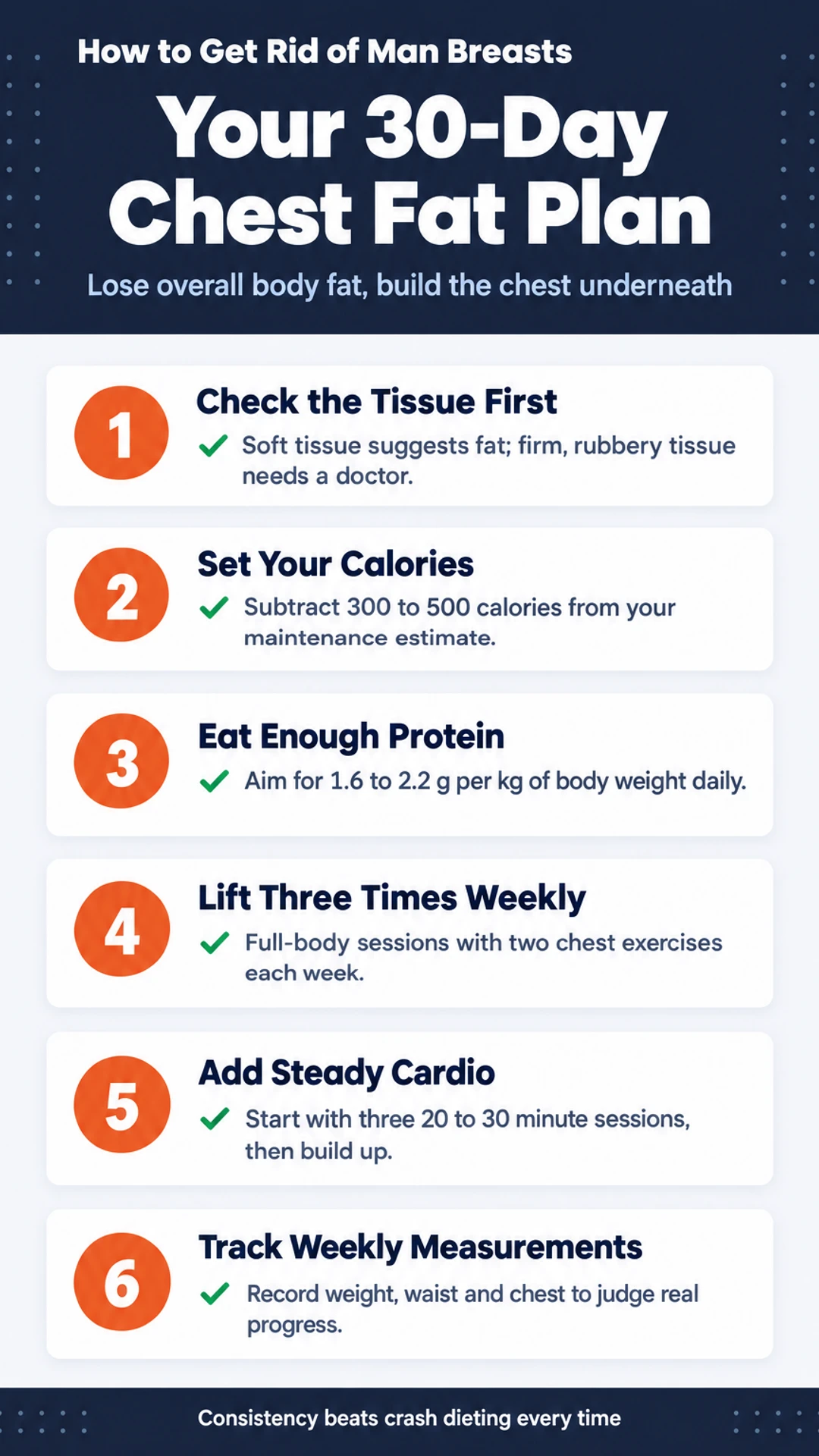
- Confirm It Is Fat and Set Realistic 30-Day Expectations
- Set Your Calorie Deficit and Protein Target
- Build a Four-Week Training Schedule
- Add Cardio and Daily Movement
- Fix the Habits That Undo the Plan
- Track Progress With Measurements and Decide What Comes Next
Step 1: Confirm It Is Fat and Set Realistic 30-Day Expectations
Before you start a plan, check whether the tissue on your chest is fat or glandular. The two look similar but respond differently. Chest fat is fat tissue, and it goes down when your overall body fat drops. Gynecomastia is an enlargement of glandular breast tissue, and a diet and exercise plan will not reliably remove it. Exercise, including bench press and other chest training, builds the muscle under the tissue but does not reduce glandular tissue.
A simple check helps. Pinch the area just below the nipple and to the side. Soft, pliable tissue that mostly moves with your body fat suggests fat. A firm, rubbery disc under the nipple suggests glandular tissue.
See a doctor if you notice any of these:
- Firm, rubbery, or hard tissue behind the nipple
- Tenderness or pain in the area
- Enlargement on one side only
- Nipple discharge
- A recent weight change, or a change that followed starting or stopping a medication, excess alcohol, or a hormonal shift
Set your baseline before you begin:
- Weigh yourself first thing in the morning, after using the toilet and before eating, for three mornings. Use the average.
- Measure your chest at nipple height with a soft tape, relaxed, not flexed. Record the number.
- Measure your waist at the navel.
- Take front, side, and angled photos in the same light, same spot, and same clothing.
For a realistic month, most visible change comes from overall fat loss, and your chest rarely changes alone. Expect a modest drop in weight and waist size over 30 days, not a dramatic transformation of one area.
Chest fat vs glandular tissue
| Tissue | What it is | Responds to diet and exercise |
|---|---|---|
| Chest fat | Fat tissue | Yes, goes down as body fat drops |
| Gynecomastia | Glandular breast tissue | Not reliably |
Step 2: Set Your Calorie Deficit and Protein Target
Before you change what you eat, you need two numbers: your daily calorie target and your daily protein target. Pick them once, and keep them for the full 30 days. Changing the plan every few days is the most common reason men stall.
What you need: a standard online TDEE (total daily energy expenditure) calculator, a kitchen scale, and a notes app or paper log.
- Estimate maintenance calories. Enter your age, sex, height, weight and activity level into a TDEE calculator. The result is roughly how many calories you burn in a day. Be honest about activity. If you train three times a week, choose “moderately active,” not “very active.”
- Subtract a moderate deficit. Take off 300 to 500 calories per day. That range typically produces steady loss without the constant hunger that makes people quit. A man whose estimate is 2,600 calories would aim for about 2,100 to 2,300.
- Calculate protein. Aim for 1.6 to 2.2 g per kg of body weight (about 0.7 to 1 g per lb). For an 85 kg (187 lb) man, that is roughly 135 to 185 g per day. Protein helps keep muscle while you lose fat, so your chest looks firmer, not just smaller.
- Write both numbers down and check them against your log each evening.
Week-one meal structure: build each meal around a palm-sized protein source, add vegetables, and include a carbohydrate such as rice or potatoes around your training sessions. Keep added sugar, sweetened drinks and fried food to a minimum.
Crash diets backfire here. Cutting to 1,200 calories causes fatigue, poor training and rebound eating, and all three work against a 30-day goal. A moderate deficit you can hold is the plan that actually gets you there.
Step 3: Build a Four-Week Training Schedule
Chest fat does not respond to chest exercises alone, so this plan trains your whole body and gives your chest two focused sessions each week. Plan for three full-body sessions per week, spaced so you have a rest day between them. Each major muscle group gets two to three sessions weekly, and chest work appears twice.
What you need:
- A bench, two dumbbells (or a barbell and rack), and a cable machine or resistance bands
- A notebook or app to log sets, reps and weight
- A tape measure for tracking progress later
How to set up each week:
- Pick two chest exercises from this list: push-ups, dumbbell or barbell bench press, dumbbell flyes, and cable crossovers.
- Add one pulling exercise (rows) and one leg exercise (squats or lunges) to each session.
- Use the set and rep ranges below.
Weekly targets:
- Weeks 1 and 2: 3 sets of 10 to 12 reps. Choose a weight where the last two reps feel hard but your form holds.
- Weeks 3 and 4: 4 sets of 8 to 12 reps. Raise the load or harder variation (for example, feet elevated push-ups) once you reach the top of the rep range.
Example: In week one, you bench press 20 kg dumbbells for 3 sets of 10. In week three, you move to 4 sets, and when you hit 12 reps on every set, you increase to 22.5 kg.
Note that the bench press and flyes build the pectoral muscle under the fat, which can improve chest shape. They do not burn chest fat directly. Fat loss comes from your overall calorie balance, so pair this schedule with your eating plan and watch your alcohol intake, since excess drinking can slow progress. No gym? Use the bodyweight version of this plan, and see our guides on home and no-gym routines for alternatives.
Weekly training targets
| Weeks | Sets | Rep range |
|---|---|---|
| Weeks 1 and 2 | 3 sets | 10 to 12 reps |
| Weeks 3 and 4 | 4 sets | 8 to 12 reps |
Step 4: Add Cardio and Daily Movement
Cardio and everyday movement raise your calorie burn without asking your chest to recover from heavy lifting every day. That matters because training hard on top of a tight eating plan can leave you flat, sore and short on sleep. Steady activity keeps the plan sustainable across the full 30 days.
Start in week one with three cardio sessions of 20 to 30 minutes each. Brisk walking, cycling or rowing all work well. Keep the effort moderate: you should be able to talk in short sentences but not sing. For example, a man who has done little exercise might walk briskly around his neighbourhood on Monday, Wednesday and Friday evenings, then add five minutes to each session every week.
By the end of the month, aim for about 150 minutes of moderate cardio per week, spread across the days. In weeks three and four, you can add one or two short HIIT sessions of 15 to 20 minutes, such as 30 seconds hard followed by 60 seconds easy, if your legs and energy levels feel recovered. Skip them if you feel run down.
Set a daily step target that matches where you start. If you average 4,000 steps now, begin with 5,000 and add roughly 500 steps every week. Many people find a phone or watch counter the easiest way to track this.
To avoid overdoing it, watch for poor sleep and constant fatigue. If you are sleeping badly or dreading your sessions, cut back a session or two. Recovery is what lets your body adapt, and a tired plan is an easy plan to abandon.
Step 5: Fix the Habits That Undo the Plan
Your training and eating can be solid and still stall if everyday habits work against them. Alcohol, short sleep and high stress all push your appetite and food choices in the wrong direction, and that makes it harder to create the calorie deficit that reduces body fat. This step covers three habits to fix, plus one myth to drop.
Cut back on alcohol. Alcohol adds calories with little nutritional value, and it tends to loosen your food decisions in the evening. A practical limit for most men trying to lose fat is no more than two standard drinks on two or three days a week, and ideally none on training-heavy days. A standard drink is roughly 14 grams of pure alcohol: a 355 ml beer, a 150 ml glass of wine, or a 44 ml shot.
Sleep seven to nine hours. Short sleep is linked to higher hunger and poorer food choices the next day. Set a fixed bedtime, keep screens out of bed, and keep the room cool and dark. Track your sleep for a week and aim for at least seven hours on most nights.
Manage stress and water.
- Walk for 20 to 30 minutes every day. Walking lowers stress without adding fatigue that cuts into your training.
- Drink a glass of water with each meal, plus one more during the day, and keep a bottle on your desk.
Drop the spot-reduction myth. No exercise, including the bench press or any chest movement, burns fat from your chest alone. Your body draws fat from wherever it is stored as your overall body fat falls. The whole plan drives the change in your chest, so consistency across all five steps matters more than any single exercise.
Step 6: Track Progress With Measurements and Decide What Comes Next
Weight alone will not tell you whether your chest is changing. Measure three things so you can see the pattern clearly. Every Monday morning, before you eat or drink, record your body weight, your waist at the navel, and your chest at the nipple line. Keep the tape level and snug without compressing the skin. Take front, side and angled photos every two weeks, in the same spot, with the same lighting and the same relaxed pose.
Set up a simple log, either a notebook or a spreadsheet, with these columns: date, weight, waist, chest, sleep hours, and training completed (yes or no). This makes patterns easy to see. For example, if your chest measurement stays flat for two weeks but your sleep dropped from seven hours to five, that is worth noticing before you change anything else.
Read the trend over two to three weeks rather than reacting to one day. Daily weight swings from salt, water and bowel contents are normal, and a single high reading means little.
If your numbers stall for two consecutive weeks, adjust your daily calories by about 100 to 200. Reduce calories if your waist and weight are both flat. Keep training consistent, including your bench press and other pressing work, which supports muscle in the chest region as you lose overall fat.
At day 30, choose one of three paths:
- Continue the same plan if your waist and weight are moving down and your chest is following.
- Progress training and calories if you are losing steadily but want more change in the chest.
- Book a doctor’s appointment if your chest is not changing in line with overall fat loss, or if you notice a lump, nipple discharge, pain, or unexplained hormonal symptoms. Persistent chest changes can have causes such as gynecomastia, which a doctor should assess. Excess alcohol can also affect this, so mention your drinking habits.
What to do now
- ☐ Weigh yourself three mornings and record the average as your baseline
- ☐ Measure your chest at nipple height and your waist at the navel, and record both
- ☐ Take front, side and angled photos in the same light, spot and clothing
- ☐ Use a TDEE calculator to estimate maintenance calories, then subtract 300 to 500
- ☐ Calculate your daily protein target at 1.6 to 2.2 g per kg and write both numbers down
- ☐ Plan three full-body training sessions per week, with two chest exercises in each
- ☐ Do three moderate cardio sessions of 20 to 30 minutes in week one
- ☐ Log your body weight, waist, chest, sleep and training every Monday morning
Frequently asked questions
What is the fastest way for men to lose chest fat?
There is no spot-reduction shortcut. The fastest realistic route is a moderate calorie deficit combined with consistent resistance training and daily activity, which lowers body fat across the whole body. Most men see the chest look leaner first when overall body fat drops, usually over several weeks rather than days.
Why am I skinny but still have chest fat?
Chest fat is not always tied to total body weight. Some men carry more fat in the chest area for genetic and hormonal reasons, even at a healthy weight. Lean men may also have firm pectoral muscle underneath, so the issue is often fat over the muscle rather than too much weight overall.
Do moobs ever go away?
Yes, in many cases they do. Fat in the chest responds to fat loss like fat elsewhere, so a sustained calorie deficit can reduce it. However, if the enlargement is mostly glandular tissue, it will not shrink with diet and exercise alone, and a doctor should check it, especially if it is firm, tender or one-sided.
How to tighten up moobs?
Tightening comes from two things: lowering body fat so the chest looks leaner, and building the pectoral muscles underneath so the chest has more shape. Pressing movements, push-ups and chest flies done two to four times a week, combined with steady fat loss and good posture, make the area look firmer over several weeks.
Share this: X · LinkedIn · Facebook
Summarize with AI: ChatGPT · Claude · Perplexity