
How to Reduce Chest Fat in 10 Days as a Man: What Is Realistic and a 6-Step Plan
How to Lose Chest Fat as a Man: 6 Steps That Work › How to Reduce Chest Fat in 10 Days as a Man: What Is Realistic and a 6-Step Plan
The short answer
In 10 days, most men can reduce bloating and water weight and see a modest change in appearance, but meaningful chest fat loss usually takes longer. Chest fat drops only when you eat in a sustained calorie deficit, since you cannot spot-reduce one area. A 10-day plan built on a moderate deficit, high protein, strength training and daily walking gives a realistic starting point. Track waist and photos, not just the scale.
This guide shows you what a 10-day window can and cannot do for chest fat, and gives you a six-step plan to run it. We have built it from published research on fat loss and exercise, and it is based on what the evidence supports rather than on quick fixes that promise more than the body can deliver.
What makes this guide worth following is that it separates water weight from fat loss, so you do not mistake a lighter scale reading for progress you have not made. Each step tells you what to do, roughly how much to do it, and what to expect from it.
Our own approach here is editorial. We have not personally trialled the training methods or products mentioned, so we rely on published sources and what people commonly report.
By the end, you will know how to set a modest calorie target, hit a protein goal, build a short strength routine and a daily walking habit, and measure your progress in a way that shows whether the plan is working. You will also know what a realistic 10-day result looks like, so you can judge your own results against it.
Quick steps:
- Confirm What You Are Dealing With Before You Start
- Set Honest Expectations for 10 Days
- Set a Moderate Calorie Deficit and High-Protein Target
- Build a Simple Training Routine That Covers the Chest and the Whole Body
- Add Daily Movement, Sleep and Hydration
- Track Results Properly and Plan What Comes Next
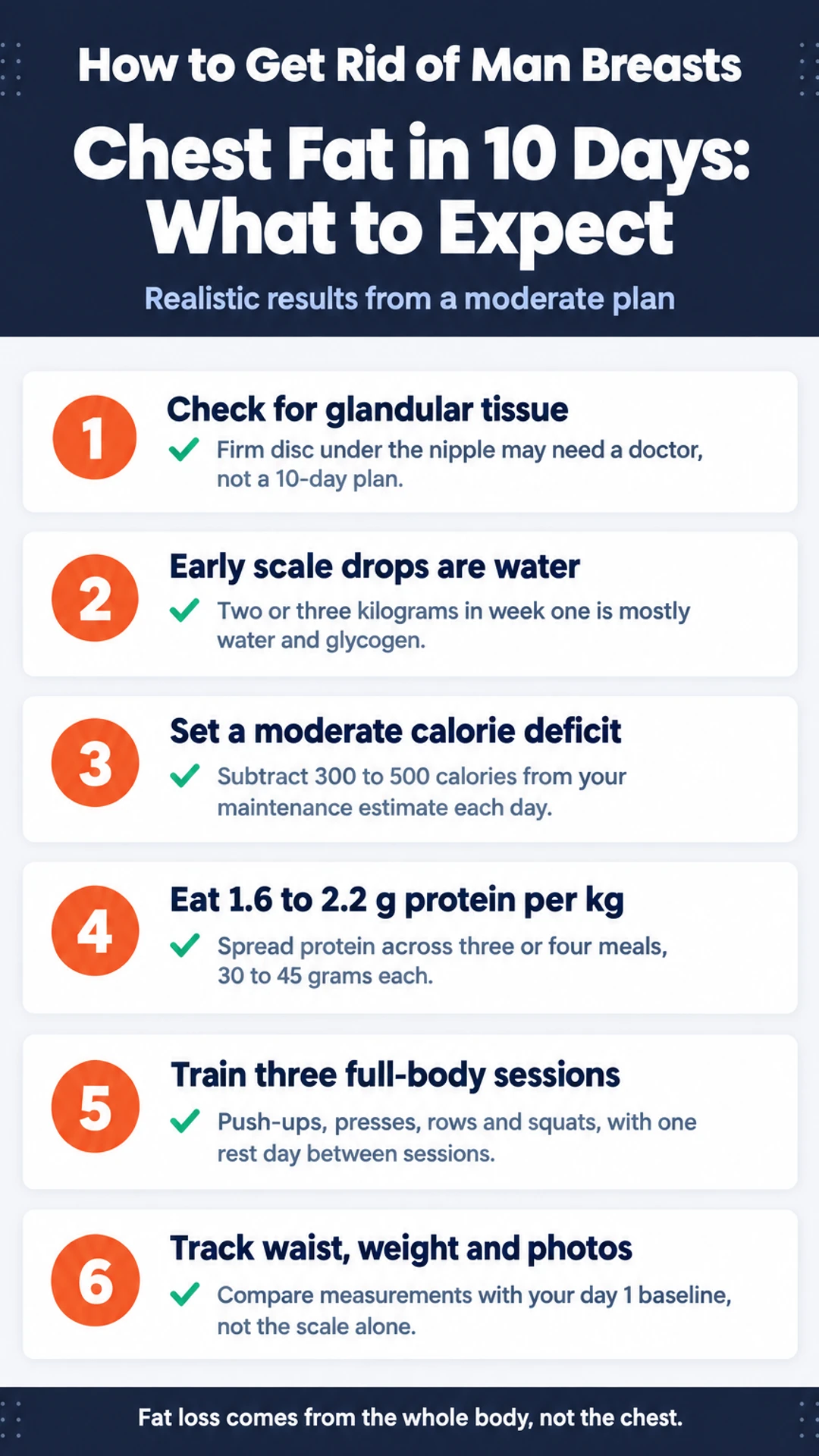
Step 1: Confirm What You Are Dealing With Before You Start
Before you commit to any plan, find out what is actually causing the change in your chest. Two very different things can look alike: chest fat and gynecomastia, which is an enlargement of glandular breast tissue under the nipple. Fat is soft and moves with your weight, so it tends to shrink as your body fat drops. Glandular tissue is usually firmer, sits in a disc right under the nipple, and is often tender. Gently press the area with your fingertips. If you feel a firm, rubbery disc that extends past the edge of the areola, you are probably dealing with glandular tissue, or a mix of both. Diet and exercise can reduce fat, but they will not shrink glandular tissue in ten days.
See a doctor, not a 10-day plan, if you notice:
- A firm, hard lump that does not move easily
- Enlargement on one side only
- Discharge from the nipple, especially bloody or clear fluid without squeezing
- Pain that is new, persistent or getting worse
- Skin dimpling, redness or changes in the nipple
Take baseline measurements so you can judge progress honestly:
- Chest circumference at the nipple line, measured with a soft tape, relaxed breath out
- Waist circumference at the navel
- Morning weight, after using the toilet and before eating
- Front and side photos, taken in the same spot, same light and same posture
Record everything in a notes file with the date. Your first check-in will then show real numbers, not memory.
Fat loss versus glandular tissue
| Feature | Chest fat | Glandular tissue |
|---|---|---|
| Feel | Soft, moves with weight | Firm, rubbery disc |
| Location | Spread across the chest | Disc under the nipple |
| Responds to diet and exercise | Yes, shrinks with fat loss | Not in ten days |
| Tenderness | Usually not stated | Often tender |
Step 2: Set Honest Expectations for 10 Days
Before you change anything, decide what ten days can and cannot show you. Most of the disappointment people feel in the first two weeks comes from expecting fat loss that the body has not had time to produce.
Your first scale drops are mostly water and glycogen, not fat. Glycogen is the stored form of carbohydrate in your muscles and liver, and each gram of it holds several grams of water. When you cut back on salt, alcohol and refined carbs, you shed that stored water quickly. You may lose two or three kilograms in the first week and feel leaner, but very little of that is fat. Treat it as a useful sign that bloating is easing, not as proof that your chest fat is gone.
Fat loss does not happen in one spot. Your body draws on stored fat from across the whole body, and chest fat is no exception. Ten days rarely produces a clear, lasting change in chest fat alone, and you cannot target the chest with a plan that only works the chest. If a fat-loss program promises otherwise, be skeptical.
A realistic goal for the first ten days looks like this:
- Better posture: you stand taller and your shoulders sit back more easily.
- Less bloating: your midsection and chest look flatter in the morning.
- A modest waist reduction: often a centimetre or two, measured the same way each time.
- A clear baseline: you have measurements and photos to compare at day 30.
What to expect at each stage
| Change | What drives it | Realistic in 10 days |
|---|---|---|
| Early scale drop | Water and glycogen | Two or three kilograms possible |
| Less bloating | Less salt, alcohol and refined carbs | Flatter midsection in the morning |
| Waist reduction | Overall calorie deficit | A centimetre or two |
| Chest fat loss alone | Overall body fat reduction | Rarely clear or lasting |
Step 3: Set a Moderate Calorie Deficit and High-Protein Target
Fat loss comes from eating less energy than your body uses. Chest fat is no exception, and you cannot spot-reduce it with a press or any other chest exercise. Over 10 days, what you eat matters more than almost anything else in this plan.
Start by estimating your maintenance calories, the amount you eat to hold your current weight. Use any standard TDEE (total daily energy expenditure) calculator, enter your age, height, weight, sex and activity level, and note the result. Then subtract 300 to 500 calories per day. For example, if the calculator gives 2,600 calories, aim for about 2,100 to 2,300.
Next, set your protein target. Multiply your body weight in kilograms by 1.6 to 2.2 grams. A man weighing 85 kg needs roughly 136 to 187 grams of protein daily. Spread it across three or four meals, aiming for 30 to 45 grams each. Good sources include:
- Eggs and egg whites
- Chicken breast and lean turkey
- Fish such as cod, salmon or tuna
- Plain Greek yogurt
- Lentils, chickpeas and beans
Cut out processed food, added sugar, sugary drinks and alcohol for the 10 days. Fill half your plate with vegetables at lunch and dinner. This keeps your intake low and your muscle intact. Keep your training going too, since it helps protect the muscles under the chest area while you lose fat.
Step 4: Build a Simple Training Routine That Covers the Chest and the Whole Body
Over 10 days, three full-body strength sessions is enough. You are not trying to shrink the chest in isolation. You are building muscle under the fat and supporting the overall fat loss that does the real work.
Schedule your sessions on days 1, 4 and 7, or 1, 3 and 6 if that suits your week. Leave at least one rest day between sessions, because each one works the chest, shoulders and triceps again. Use this set of exercises in each session:
- Push-ups, or incline push-ups if full push-ups are too hard
- Dumbbell chest press, or floor press if you only have one pair of weights
- Dumbbell or band rows for the back
- Bodyweight or goblet squats for the legs
Do 2 to 4 sets of 8 to 15 reps for each exercise. Pick a load or difficulty where the last two or three reps are hard but your form holds. For example, if you can do 12 clean incline push-ups, the first set of 12 should feel challenging, and you rest 60 to 90 seconds before the next set.
Focus on control. Lower the weight for a count of two or three, pause briefly with your chest stretched, then press back up. Use the full range of motion, lowering until your chest is near the floor or the dumbbells reach a comfortable stretch, instead of bouncing through short reps.
Keep this in perspective. Training builds the muscle that sits beneath chest fat and improves how your body looks as you lose weight. It does not burn fat from the chest alone. The results come from the calorie deficit you set with your eating, so treat the workouts as support for that plan, not a replacement for it.
Step 5: Add Daily Movement, Sleep and Hydration
Fat loss from the chest area depends on your overall calorie deficit, not on any single exercise. Chest training builds the muscles underneath, but it does not burn the fat on top of them. The three habits below support your deficit and help you feel less puffy, so you can hold them for the full 10 days.
Move daily. Walk 30 to 45 minutes most days, or do 20 to 30 minutes of moderate cardio such as cycling or brisk walking. Keep the effort steady enough that you can talk in short sentences. A typical day might look like a 35-minute walk after dinner, which adds a few hundred calories of burn without making you too tired to train.
Sleep 7 to 9 hours. Short sleep tends to raise hunger and cravings, which makes a deficit harder to hold. Set a fixed bedtime and keep it for all 10 days.
Drink water and keep sodium moderate. Spread your water intake through the day rather than drinking it all at once. Keep salty processed foods in check to reduce puffiness. You do not need extreme measures. Dehydrating yourself only makes you feel worse and does not help.
Keep a simple checklist:
- Walk or do cardio on most days
- Sleep 7 to 9 hours each night
- Drink water steadily through the day
- Limit high-sodium snacks and restaurant meals
Step 6: Track Results Properly and Plan What Comes Next
Ten days is too short to see much change in chest fat, and the scale can mislead you in either direction. The goal of this step is to measure your progress fairly so you know what actually changed and what to do next.
What you need:
- A soft tape measure
- A bathroom scale
- Your baseline numbers from Day 1
- A phone camera and a plain wall
On Day 10, measure under the same conditions as Day 1:
- Wake up, use the toilet, then weigh yourself before eating or drinking.
- Measure your waist at the navel, keeping the tape level and snug but not compressed.
- Measure chest circumference just under the armpits, across the nipple line.
- Take front, side and angled photos in the same spot, lighting and posture.
Compare the numbers. For example, if your waist went from 36 to 35 inches and your weight dropped 2 pounds, the waist change is the more meaningful signal. A drop of 2 pounds in a single day is usually water and salt, not fat.
Read the trend, not single days. Weigh yourself daily and look at the weekly average. Water shifts with sodium, carbohydrates and training soreness, so one heavy morning means little.
Once you have your Day 10 results, keep going. Lasting change in chest fat takes longer, and our 30-day plan for reducing chest fat lays out a realistic month. For the full approach, see the hub page on how to lose chest fat for guys.
What to do now
- ☐ Confirm whether the change is fat or glandular tissue by pressing gently with your fingertips
- ☐ See a doctor if you notice a firm lump, one-sided enlargement, nipple discharge, or new or worsening pain
- ☐ Record baseline chest and waist measurements, morning weight, and front and side photos
- ☐ Set expectations that the first ten days mostly show water loss, posture and waist change, not chest fat loss
- ☐ Estimate maintenance calories and subtract 300 to 500 calories per day
- ☐ Set a protein target of 1.6 to 2.2 grams per kilogram of body weight, spread over meals
- ☐ Schedule three full-body strength sessions on days 1, 4 and 7, or 1, 3 and 6
- ☐ On Day 10, repeat the same measurements and photos under the same conditions as Day 1
Frequently asked questions
How to lose chest fat male fast?
Fat loss across the body is what reduces chest fat, and it cannot be targeted to the chest. The fastest honest approach is a moderate calorie deficit of roughly 300 to 500 calories a day, combined with strength training and enough daily steps. Expect visible change over several weeks, not days. Quick drops in the first week are mostly water and glycogen.
How do I flatten my chest as a man?
Chest flattening comes from reducing overall body fat and building the pectoral muscles underneath. Lower body fat through diet and regular cardio, then train the chest with push-ups, presses or dips two or three times a week. Good posture also makes the chest look flatter. If the tissue feels firm and does not change with fat loss, it may be glandular rather than fatty, and a doctor can check.
Can I hit my chest 3 days a week?
Yes, training the chest three days a week is common and works well for most people. Two to four sets per session across varied movements, such as push-ups, dumbbell presses and incline work, is usually enough. Allow at least 48 hours between heavy sessions for the same muscle group, and make sure you are recovering from sleep and food. Consistency matters more than frequency.
How can I slim down my chest?
You slim the chest the same way you slim the rest of the body: eat fewer calories than you burn, keep protein high to hold onto muscle, and move more each day. Walking, resistance training and sleep all help. Spot reduction, such as chest-only exercise or fat-burning creams, does not shrink fat in one area. Most visible change appears after about six to eight weeks of steady effort.
Can you lose chest fat in 10 days?
You can lose a small amount of weight in 10 days, but most of it is water and stored carbohydrate rather than fat. A realistic fat loss rate is about half a kilogram to one kilogram a week for most men. Ten days can establish habits and show early progress, but a noticeable change in chest appearance usually takes longer. Measure with photos and a tape rather than the scale alone.
Conclusion
Which step will you try first?
- Setting a modest calorie deficit and tracking it for a week
- Adding two or three chest sessions to your schedule
- Taking a set of photos and tape measurements as a baseline
Starting with one of these gives you a clear result to check after ten days.
Share this: X · LinkedIn · Facebook
Summarize with AI: ChatGPT · Claude · Perplexity