
How to Reduce Chest Fat as a Man Without a Gym: 6 Steps at Home
How to Lose Chest Fat as a Man: 6 Steps That Work › How to Reduce Chest Fat as a Man Without a Gym: 6 Steps at Home
The short answer
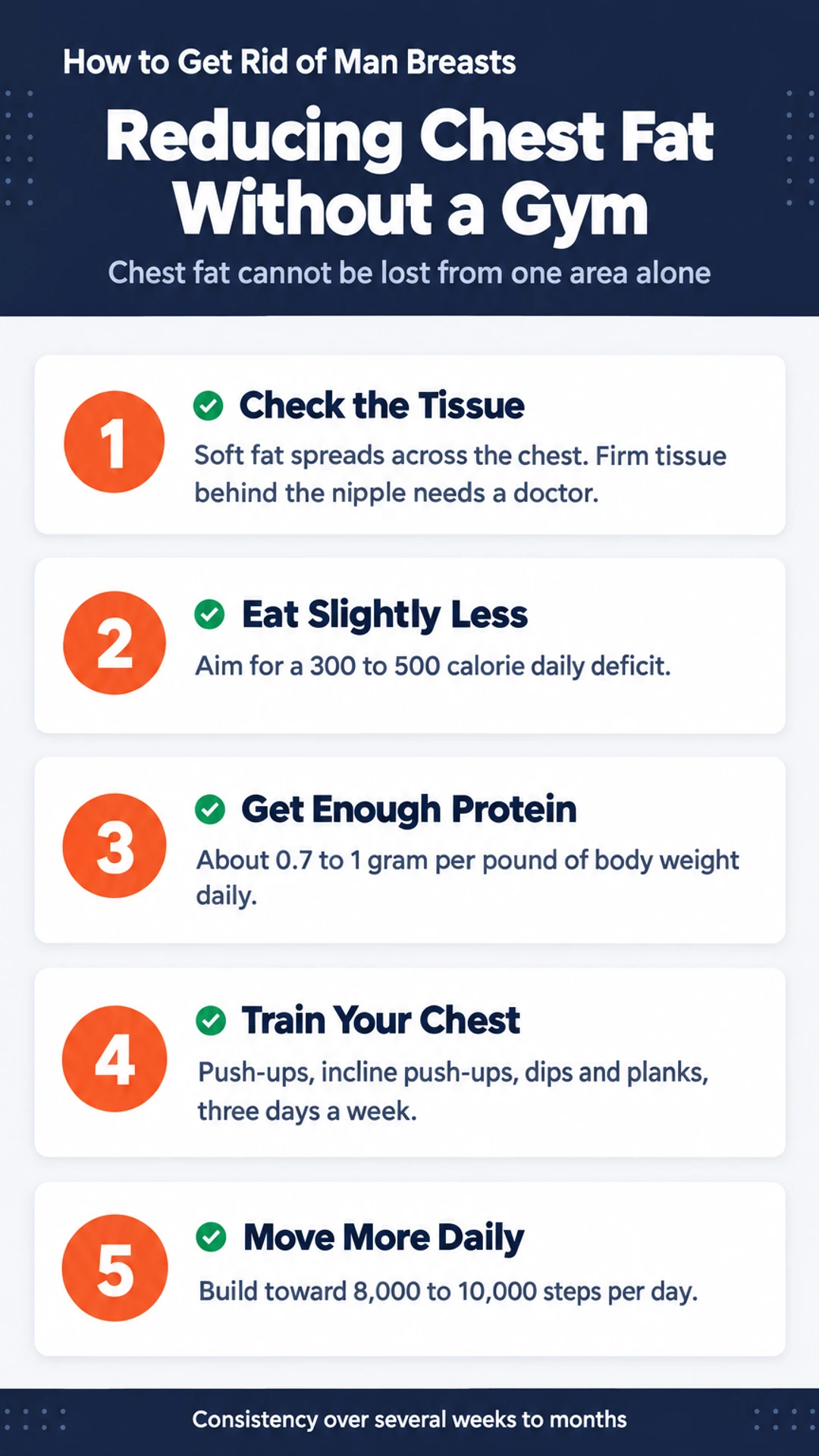
To reduce chest fat without a gym, eat fewer calories than you burn, eat enough protein, and lower overall body fat, since fat cannot be lost from the chest alone. Add bodyweight chest and core training such as push-ups, incline push-ups and planks, plus regular walking or brisk cardio. Most men see the change over several weeks to months, and the result depends on consistency.
By the end of this guide, you will have a home routine you can run three to four times a week with nothing but your body and a sturdy chair or table. You will know how to set a daily calorie target you can hold, how much protein to aim for each day, and how to build your walking and push-up work so it gets harder over time.
We wrote this page for the equipment-free path, so every step relies on bodyweight training, daily movement and simple changes to what you eat. We have kept the advice specific: where a number helps, such as a daily step goal or a set count for incline push-ups, you will find it stated plainly.
This guide is based on established training and nutrition principles and on what men commonly report when they follow a no-equipment plan, not on our own testing.
When you finish the six steps, you will be able to put together a complete week of training, eating and walking at home, and adjust it yourself when progress stalls. If you want the broader picture first, our hub page on how to lose chest fat for guys covers what works and what doesn’t. The companion pages on 10-day, 30-day and at-home routines go deeper on timelines and exercises.
Quick steps:
- Confirm What You Are Dealing With
- Set a Calorie Target and Protein Floor
- Build a Bodyweight Chest and Core Routine
- Add Daily Movement and Cardio
- Support Fat Loss With Sleep, Alcohol and Stress Habits
- Track Progress and Set Realistic Expectations
Step 1: Confirm What You Are Dealing With
Before you start any plan to reduce chest fat, find out what the tissue actually is. Chest fat and gynecomastia look similar from the outside, but they respond to different fixes, and only one of them responds to fat loss.
Chest fat, sometimes called pseudogynecomastia, is fatty tissue spread across the chest. It usually feels soft and grows or shrinks as the rest of your body gets heavier or lighter. Gynecomastia is an increase in glandular breast tissue, which sits directly behind the nipple. It is often firm, can feel tender or sore, and may stay the same size even when your weight changes. Fat loss helps the first and does little for the second.
Do this simple check:
- Stand in front of a mirror in good light, arms relaxed at your sides.
- Gently pinch the skin on your chest about 2 to 3 cm (roughly an inch) out from the nipple, the way you would pinch a fold of skin on your stomach.
- Pinch with your thumb and fingers, then feel for a firm, rounded disc of tissue sitting directly behind the nipple, separate from the surrounding soft fat.
- Repeat on the other side and compare.
If the pinch gives you soft, pliable tissue that spreads across the chest, it points toward fat. If you feel a firm, disc-shaped button under the nipple, it points toward glandular tissue. For example, a man with a firm disc under one nipple and soft fat on the other side should not expect fat loss alone to flatten that one side.
See a doctor first if you notice any of these:
- The change is on one side only
- You can feel a lump or hard area that does not move easily
- The nipple leaks fluid, especially if it is bloody or clear
- The area grows quickly over weeks rather than months
- The nipple or skin looks dimpled, scaly, or pulled inward
Hormonal and medication causes exist, and some common drugs and conditions can contribute. A clinician can check hormone levels, including testosterone, and review your medications. Bring that list to the appointment.
Fat versus glandular tissue
| Feature | Chest fat | Glandular tissue |
|---|---|---|
| Feel when pinched | Soft, spreads across chest | Firm, disc behind nipple |
| Location | Spread across chest | Directly behind nipple |
| Responds to fat loss | Yes | Little or none |
| Changes with body weight | Usually yes | Often stays the same size |
Step 2: Set a Calorie Target and Protein Floor
Fat loss comes down to eating less energy than you burn over time. You do not need to starve yourself to get there. A moderate deficit of roughly 300 to 500 calories per day is a common starting point for gradual fat loss, and it is a sensible one for most men. It lets you lose weight steadily while keeping your energy up for daily activity and bodyweight training. Dropping much further usually makes hunger, fatigue and cravings harder to manage.
To find your starting number, use an online TDEE (total daily energy expenditure) calculator, then subtract 300 to 500 calories. For example, if the calculator says you burn about 2,600 calories a day, aim for roughly 2,100 to 2,300. Adjust after two to three weeks based on your weight trend.
Protein matters even more when you are eating less. For active men, aim for about 1.6 to 2.2 grams per kilogram of body weight per day, or about 0.7 to 1 gram per pound. A 90 kg (about 200 lb) man would target roughly 145 to 200 grams of protein daily. Protein helps preserve muscle while you lose fat, and it keeps you feeling full.
You do not need an app to hit these targets. Use the plate method:
- Fill half the plate with vegetables.
- Fill a quarter with protein (chicken, fish, eggs, Greek yogurt, lentils, tofu).
- Fill a quarter with starches (rice, potatoes, oats, bread).
- Add a piece of fruit on the side.
Whole foods like these make the target easier to hit, because they are filling and they are simple to portion. A kitchen food scale costs little and makes portions more accurate, especially for oils, nuts and rice. It is helpful, but not required. Start with the plate method and add a scale only if your progress stalls.
Step 3: Build a Bodyweight Chest and Core Routine
Your chest is one area you can train with nothing but your own body, and a simple routine three days a week is enough to build strength and muscle. Keep in mind that exercise alone does not target fat in one spot. Training builds the chest muscle underneath, and overall fat loss through diet and daily movement is what reduces the fat on top of it. Pair this routine with the steps you have already set up.
What you need: a clear floor, a sturdy chair or bench, and a towel or mat for your knees and planks.
Starter routine (3 days a week, for example Monday, Wednesday, Friday):
- Push-ups, or incline push-ups with your hands on a chair or bench: 2 to 3 sets of 8 to 12 reps
- Dips on a sturdy chair or bench: 2 to 3 sets of 6 to 10 reps
- Pike push-ups or decline push-ups (feet raised on the bench): 2 to 3 sets of 5 to 8 reps
- Plank: 2 to 3 sets, holding 20 to 45 seconds
Rest 60 to 90 seconds between sets. Choose a version you can finish with good form.
Form cues:
- Place your hands slightly wider than your shoulders.
- Keep your body in one straight line from head to heels.
- Bend your elbows at about 45 degrees from your body, not flared straight out.
- Lower until your chest nearly touches the floor, then push back to full extension.
Progressing over time: when the routine feels easy, slow the lowering phase to three seconds, raise your feet higher, move to a harder variation, or add a loaded backpack. Train two to three times a week, with at least one rest day between sessions so your chest can recover. Strength training of this kind builds the muscles that give your chest its shape, and a steady approach to progression keeps that work effective.
Step 4: Add Daily Movement and Cardio
Most of the calories you burn in a day come from everything you do, not from one workout. Raising your daily activity is one of the most useful things you can do to support fat loss, and it fits a desk job or a busy home schedule without any equipment.
Start by finding your current average. Check your phone’s step counter or a cheap pedometer for three to four normal days. Take that average and add about 1,000 steps per week until you reach a daily target of 8,000 to 10,000 steps. If you average 4,000 now, aim for 5,000 next week, 6,000 the week after, and so on.
For structured cardio, the general guideline is 150 minutes per week of brisk walking or cycling, roughly 30 minutes on five days. If time is short, you can use shorter high-intensity intervals instead, such as 30 seconds of hard effort followed by 90 seconds of easy movement, repeated for 10 to 15 minutes.
When you cannot get outside, try bodyweight cardio in 10 to 20 minute blocks:
- Marching in place, arms swinging, for 2 minutes at a time
- High knees for 30 seconds, then rest 30 seconds
- Step-ups onto a sturdy stair or bench, alternating legs
For example, you might do three rounds of marching, high knees and step-ups during a lunch break. Walking for 10 minutes after meals also helps with daily activity and can blunt the blood sugar rise that follows eating.
Step 5: Support Fat Loss With Sleep, Alcohol and Stress Habits
Your diet and training can only work if the rest of your routine doesn’t quietly cancel them out. Poor sleep, regular drinking, sugary drinks and a chaotic schedule are the everyday habits that push your intake above target without you noticing. Fixing them is often the fastest way to make your calorie deficit stick.
Sleep 7 to 9 hours a night. Short sleep tends to increase hunger and lower how much you move during the day. To protect your sleep:
- Pick a fixed bedtime and wake time, even on weekends.
- Stop eating about two to three hours before bed.
- Keep your room cool and dark, and put your phone outside the bedroom.
Cut back on alcohol. Beer, wine and spirits add calories fast, and they can disrupt sleep and affect hormones involved in fat storage. Example: if you drink four beers on Friday and Saturday, that is roughly 800 extra calories a week before any food you eat while drinking. Try cutting to one or two drink-free days a week, or swap to a lower-calorie option.
Drop sugary drinks. Sodas, sweetened coffees and juice are easy calories you barely register. Switch to water, sparkling water, black coffee or tea. Also reduce the constant snacking that pushes your total past target.
Set a fixed weekly schedule. Stress and irregular routines make any plan harder to follow. Write down when you will train, eat your meals and sleep, then treat those slots as appointments. Consistency across the week matters more than any single good day.
Step 6: Track Progress and Set Realistic Expectations
Chest fat changes slowly, and the scale alone can mislead you. Weight fluctuates from one morning to the next with water, salt, and food in your system. Use the measurements below to judge whether your plan is working.
What you need:
- A flexible tape measure (a sewing tape works well)
- A notebook or spreadsheet
- A phone camera and a plain wall with steady light
Measure your waist weekly. Wake up, use the bathroom, and measure before you eat. Wrap the tape around your bare torso at the navel, keep it level and snug but not tight, and breathe out normally. Write down the number. Compare averages over several weeks rather than single readings.
Take photos every two weeks. Stand in the same spot, in the same lighting, at the same time of day. Take one front view and one side view with your arms relaxed at your sides.
Check how your clothes fit. Notice whether your shirts sit looser across the chest and shoulders. Fit often changes before the scale or the tape does.
Expect slow change. Spot reduction is not possible. Chest fat usually shrinks as your overall body fat drops, and that takes weeks to months. Consistent calories, training, and sleep matter more than any single week.
See a clinician if needed. If you show no change after about 8 to 12 weeks of steady effort, or if the tissue under your nipple feels firm or rubbery, book an appointment. A doctor can check for gynecomastia or a hormonal cause, and a treatment plan can be discussed from there.
What to do now
- ☐ Pinch the skin about an inch out from the nipple and feel for a firm disc behind it
- ☐ See a doctor if you notice any warning signs such as one-sided change, a lump, or nipple discharge
- ☐ Use an online TDEE calculator and subtract 300 to 500 calories for your daily target
- ☐ Aim for about 0.7 to 1 gram of protein per pound of body weight each day
- ☐ Train chest and core three days a week with push-ups, dips, pike or decline push-ups, and planks
- ☐ Check your average daily steps for three to four days, then add about 1,000 steps per week
- ☐ Sleep 7 to 9 hours, cut back on alcohol and sugary drinks, and keep a fixed weekly schedule
- ☐ Measure your waist weekly, take photos every two weeks, and compare results over several weeks
Frequently asked questions
How to lose chest fat without working out?
You can reduce chest fat without formal exercise by eating in a modest calorie deficit and walking more each day. Fat loss overall is what shrinks the chest, and you cannot choose which area it comes from. Daily walking, fewer sugary drinks and smaller portions do most of the work when a gym is not part of the plan.
How to lose male chest fat fast?
There is no reliable way to target chest fat, so speed comes from overall fat loss. A deficit of about 300 to 500 calories a day usually produces roughly half a pound to a pound of weight loss per week. Pair that with bodyweight training and daily steps, and expect visible change over weeks rather than days.
Do moobs ever go away?
Many men see chest fat shrink noticeably once body fat drops to a leaner range, and a true gynecomastia caused by glandular tissue usually does not disappear through diet or exercise alone. If the chest feels firm, tender or lumpy, or one side looks different, see a doctor to find out which type you have.
Can we lose chest fat in 7 days?
Not in a meaningful way. Seven days of dieting mostly reduces water and glycogen, so the chest may look slightly flatter but the fat itself has barely changed. Sustainable change in chest fat takes several weeks of consistent calorie control and regular movement.
Share this: X · LinkedIn · Facebook
Summarize with AI: ChatGPT · Claude · Perplexity